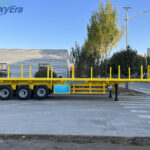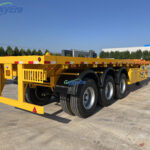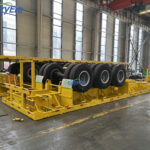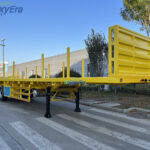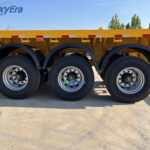
I.Let’s start with the most common: Standard Flatbed Semi-Trailer Weight
Taking the most common 3-axle 13-meter flatbed semi-trailer in the domestic and international markets as an example:
Steel flatbed semi-trailer: Weight approximately 6.5 – 8.5 tons
All-aluminum or aluminum-steel hybrid flatbed semi-trailer: Weight approximately 4.5 – 5.8 tons
The difference is about 2 tons.
What does this 2 tons mean? With the total weight limit remaining unchanged (China’s 6-axle train total weight limit is 49 tons), the aluminum flatbed trailer can carry 2 tons more cargo per trip. Over a year, the extra revenue is considerable.
If you only occasionally transport light cargo and are not sensitive to weight, the steel trailer is more cost-effective. If you drive daily and are charged by the ton, the extra purchase cost of the aluminum trailer can be quickly recovered.
II. Why such a large weight difference for the same length?
There are three core factors affecting the weight of a flatbed semi-trailer:
- Steel or aluminum?
This is the biggest variable.
Steel flatbed trucks: Cheap, sturdy, and easy to repair, but heavy.
Aluminum flatbed trucks: Lightweight, corrosion-resistant, and have a high resale value, but expensive.
A 13-meter all-aluminum flatbed truck, with its superstructure alone, is 1.5–2.5 tons lighter than a steel flatbed truck.
- Number of Axles
2-axle flatbed trucks: Lighter tare weight, but limited total load capacity.
3-axle flatbed trucks: Most common, increasing tare weight by approximately 600–1000 kg, but offering more stable and compliant load-bearing capacity.
4-axle or more: Used for transporting large items, significantly increasing tare weight.
- Reinforced vs. Standard
If you are transporting steel coils, construction machinery, or heavy equipment, manufacturers will reinforce the main beams, crossbeams, and suspension.
Reinforced models are 500–1500 kg heavier than standard models, but will not bend the frame.
Simple way to judge: Heavy cargo → Reinforced model; Light cargo → Standard model is sufficient.
III. An Easily Overlooked Issue: Curb Weight ≠ Cargo Capacity
Many buyers only look at the “tare weight,” but what truly determines your compliant cargo capacity is:
Maximum Permissible Gross Vehicle Weight – Curb Weight = Actual Cargo Limit
For example:
A 13-meter flatbed semi-trailer has a publicly announced curb weight of 7.8 tons.
The tractor unit (6×4) has a tare weight of 8.8 tons.
The train’s maximum permissible gross vehicle weight is 49 tons.
Therefore, the maximum legal cargo capacity is approximately:
49 – 7.8 – 8.8 ≈ 32.4 tons
If you buy a lighter vehicle (e.g., 6.5 tons), with the same tractor unit, the cargo capacity can be increased to 33.7 tons.
That’s an extra 1.3 tons per vehicle, which translates to an additional 260 tons of transport capacity per year for 200 trips.
IV. Vehicle Purchase Recommendations: Choose Weight Based on Your Business
Scenario 1: General Freight, Less-than-Truckload (LTL), Express Delivery
Prioritize Lightweight (Aluminum or Aluminum-Steel Hybrid)
Target Tare Weight: 5.0 – 6.5 tons
Scenario 2: Steel, Cement Components, Heavy Equipment
Choose Reinforced Steel Flatbeds; Heavier but More Durable
Target Tare Weight: 7.5 – 9.0 tons
Scenario 3: Long-Distance Driving, Freight Charges Based on Ton
Strongly Recommend All-Aluminum
Target Tare Weight: 4.5 – 5.8 tons
Scenario 4: Limited Budget, Short Distance, Fixed Routes
Standard Steel Flatbeds are Sufficient
Target Tare Weight: 6.5 – 8.0 tons
V. Don’t Just Look at Weight; Consider These Three Other Factors
Weight is an important indicator, but not the only one. When choosing a vehicle, it’s recommended to ask about the following:
The material and thickness of the frame (affects lifespan).
Whether the floor is flat or patterned (patterned floor is slightly heavier but more slip-resistant).
Whether the suspension is leaf spring or air suspension (air suspension is slightly heavier but provides better shock absorption and protects cargo).
A good salesperson will proactively tell you these details, rather than just providing a weight figure.