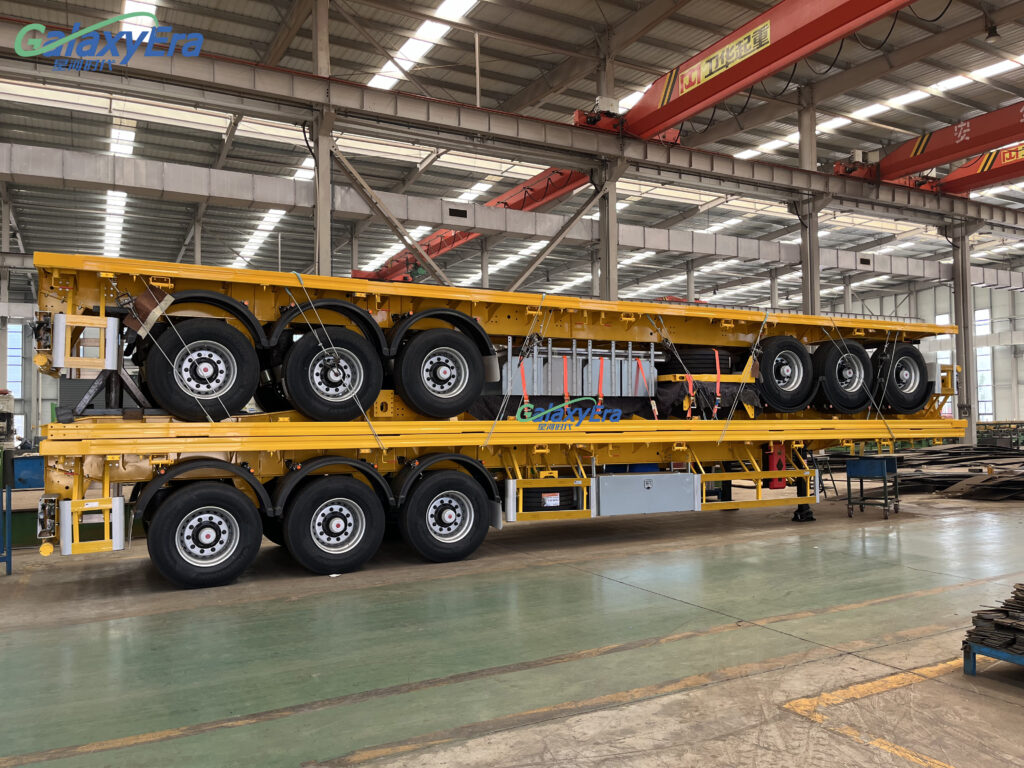
Those of you in the transportation industry have probably noticed in the past two years that truck prices, like fuel prices, fluctuate wildly, but overall haven’t decreased much. This is especially true for flatbed semi-trailers. Whether hauling containers, steel, or equipment, the biggest dilemma when considering adding a truck is: spend tens of thousands more on a new one, or save money and get a used one to make do?
Having driven the truck for several years and inquired with many manufacturers and used truck dealers for friends, I’ll tell you the real market situation in 2026. No fluff, just price ranges and comparisons.
First, let’s talk about the price of a brand new flatbed semi-trailer
In 2026, the price of a standard new flatbed semi-trailer mainly depends on these factors: number of axles, length, steel materials, and suspension type.
Taking the most common 3-axle 40-foot flatbed semi-trailer as an example, with a standard carbon steel frame, mechanical leaf spring suspension, standard tires, and ABS, the factory price in Shandong province is approximately between US$12,000 and US$18,000 (equivalent to RMB 85,000 to RMB 130,000). If you use high-strength steel, choose air suspension, and add alloy wheels, the price can jump to US$25,000 and above.
Reference Prices for Different Axle Counts (Brand New, Direct from Chinese Factory, FOB Qingdao/Shanghai):
-2-Axle 20ft Light Flatbed: $8,000 – $11,000
– 3-Axle 40ft Standard Flatbed: $12,000 – $18,000
– 4-Axle 60-ton Heavy-Duty Flatbed: $18,000 – $25,000
– 5-Axle 80-ton Extra-Heavy-Duty: $25,000 – $35,000
These are ex-factory prices, not including sea freight, destination port duties, and local registration fees. Shipping to the US, Australia, or Africa will almost double the price (freight + taxes are the major costs).
What is the Price of a Used Flatbed Semi-Trailer?
The price of a used flatbed semi-trailer varies greatly, mainly depending on the vehicle’s age, condition, whether it has been in accidents, the number of tires remaining, and whether the undercarriage is rusted.
Generally speaking, a 3-year-old used car, if well-maintained, will cost approximately 50%–65% of a new car. That means a 3-axle 40-foot flatbed truck originally priced at $15,000 might sell for around $7,500–$9,500 after three years.
5-year-old cars: Prices generally drop to 35%–45%of the new car price, roughly $5,000–$7,000. However, note that the tires, brake pads, and electrical system of a five-year-old car may need replacing; adding these costs, the price is roughly the same as buying a three-year-old car.
8- to 10-year-old cars: Prices vary widely, ranging from $2,000 to $4,000. These are suitable for short-distance travel, personal use, and those who don’t mind repairs. If you plan to drive long distances or work for a company, avoid them; repair costs will exceed the purchase price.
New vs. Used: How to Choose?
I’ll list a few scenarios for you; see which applies to you.
Suitable for Buying a New Vehicle:
– If you drive long distances, handle heavy loads, or have a long-term contract with a large logistics company, and your vehicle breaks down, you’ll be penalized. New vehicles have a lower failure rate and are worry-free during the warranty period.
– If you have specific requirements for features, such as air suspension, an aluminum alloy floor, or a custom length, it’s difficult to find a suitable used vehicle.
– If you have access to financing, new vehicle loan interest rates are often lower than used car rates.
Suitable for Buying a Used Vehicle:
– If you’re new to the industry, don’t have much cash, and want to test the waters. Buying a three-year-old vehicle for around $7,000-$8,000 will allow you to resell it after two years without losing much money.
– For short trips, internal transport within construction sites, or personal use on a farm, where the vehicle’s condition isn’t critical—as long as it can run—you can buy a five- or six-year-old or even older vehicle.
– If you can repair the vehicle yourself or have a friend who does. Used trailers often have minor issues, but if you know how to fix them, you can save a lot of money.
Market Changes and Reminders in 2026
A new situation arises this year: steel prices have fallen slightly compared to the previous two years, and the ex-factory price of new cars is actually about 5%–8% lower than in 2023. However, the problem is that shipping costs and inflation have pushed up the final price. So, if you are abroad, buying a new car may not feel cheap.
Additionally, the requirements for trailer emissions and lighting in the US and Europe are becoming increasingly strict. Older used cars may not meet the new standards and cannot be driven on the road. Make sure you check the regulations of your destination before buying.
Another point: Don’t be fooled by a nicely painted exterior on a used car. Always lift it up to inspect the floor, frame, and suspension. Many used car dealers just give it a quick rinse and a paint job and sell it as a premium product. It’s best to bring a knowledgeable friend or ask to test drive it for several dozen kilometers.
A Direct Conclusion
– If you have a sufficient budget (over $20,000 on the road), intend to use it long-term, and don’t want to deal with any hassle → Buying a new car, the 3-axle 40-foot standard configuration is the most cost-effective.
– If you’re on a tight budget (under $10,000) and want to practice driving or do short trips → buy a used truck around 3 years old for the best value.
– Never buy a truck over 8 years old for long-distance driving; the few thousand dollars you save won’t cover a single repair.
If you plan to buy a new truck from China for export, contact the factory directly for a quote. Remember to clarify whether it’s FOB or CIF. Don’t just focus on the cheapest truck price; shipping and miscellaneous fees can easily add another three or four thousand dollars to your bill.
Finally, let me be honest: a flatbed semi-trailer is just a tool. Buying an expensive one isn’t a big deal, but buying a cheap one and causing delays is truly painful. Consider your routes and cargo volume, not just the price.