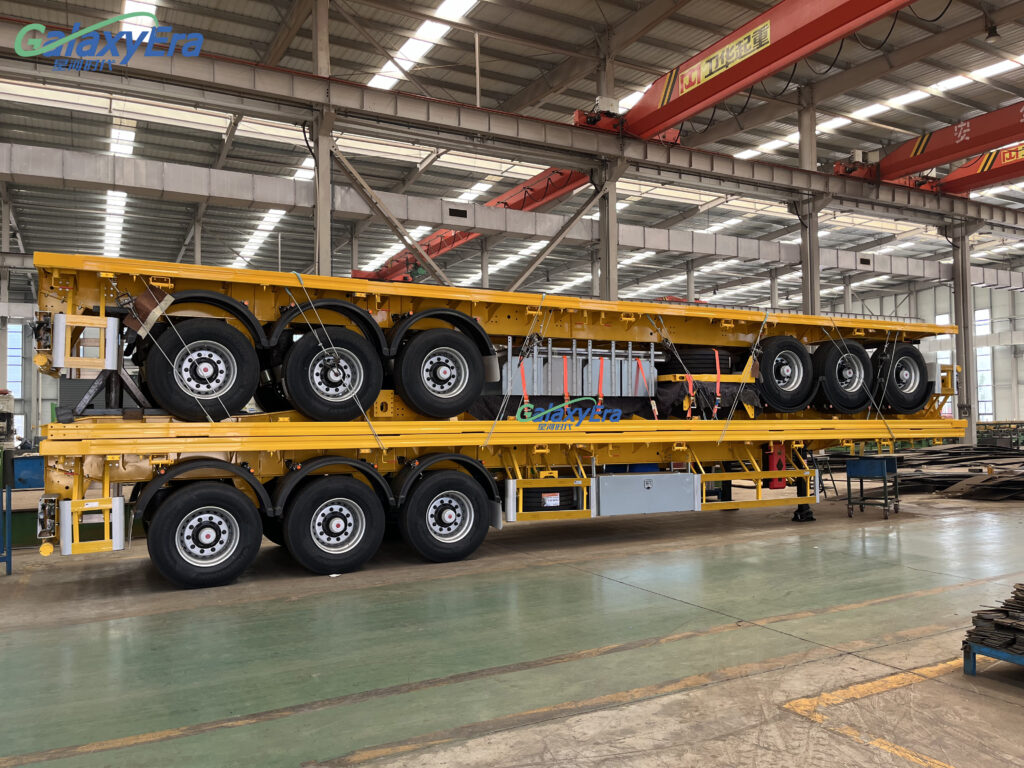
You’ve seen the headlines: “Flatbed trailers are simple. Just buy the cheapest one.”
Then six months later, you’re bleeding money on tires, getting pulled into weigh stations for axle violations, and watching your deck rust faster than you can say “maintenance.”
I’ve been around flatbed trailers for 12 years – not as a blogger, but as someone who has helped fleets spec, repair, and sell hundreds of them. Most buyers focus on price per pound of GVWR. That’s a mistake.
Here are three real, often ignored costs that eat your profits. Fix them before you sign the PO.
Hidden Cost 1:
Axle spacing that fights the law (and your fuel bill)
Most cheap flatbeds use 49-inch axle spacing because it saves a few feet of frame steel. That spacing works – but only for certain gross weights.
Here’s the FMCSA rule (23 CFR 658.17):
A tandem axle group (two axles close together) can carry a maximum of 34,000 lbs if the spacing between the two axles is at least 40 inches.
But to reach the full 80,000 lbs GCWR (truck + trailer combined), your outer axle spacing must be at least 121 inches.
What that means in real life:
A 3‑axle flatbed with tight spacing (say, 49” between 1 and 2, and another 49” between 2 and 3) will have a legal GVWR of only about 68,000–72,000 lbs on many highways. Not 80,000.
So you pay for an “80k trailer” but you can only load to 72k. That’s 8,000 lbs of lost payload per trip. At 100 trips/year, that’s 800,000 lbs of goods you could have hauled but didn’t.
What to ask your supplier before buying:
“What’s the outer axle spread (center of first axle to center of last axle) on your 3‑axle flatbed?”
If it’s under 121 inches, ask for a custom spread. Good manufacturers will charge a little extra for a longer frame. It’s worth it.
See our compliant 3‑axle flatbed specs → [https://flattrailer.com/products/3-axles/]
Hidden Cost 2:
“Standard duty” crossmembers that sag under real loads
This one kills you slowly.
Many flatbeds come with 4‑inch steel I‑beam crossmembers spaced 18 to 24 inches apart. That’s fine for pallets of dry goods. But put a 25,000‑lb steel coil, a skid of concrete blocks, or a compact track loader on that deck – and those crossmembers will bend.
I’ve seen a brand new “heavy duty” flatbed from a discount builder develop a 0.5‑inch permanent sag after just three months of hauling rebar coils. The owner didn’t notice until tires started cupping and the fifth wheel wouldn’t lock smoothly.
What the sales guy doesn’t tell you:
“Heavy duty” often just means thicker paint.
The actual strength comes from crossmember height (5″ or 6″ instead of 4″), spacing (12″ or 16″ on center), and steel grade (Q550 or better).
Ask for these three numbers:
Crossmember height
Crossmember spacing
Steel yield strength (minimum 550 MPa for real work)
If the seller hesitates or says “industry standard” – that’s code for “cheap.”
[Compare our reinforced flatbed crossmember options →] [https://flattrailer.com/product/3-axle-40ft-flatbed-trailer/]
Hidden Cost 3:
Tie‑down points that look plentiful but waste your time
You see a flatbed with 16 stake pockets and think “plenty of straps.” Then you try to secure a load of lumber that overhangs the sides by 2 feet. You can’t hook a strap from the pocket – it would pull at a bad angle and slip off.
So you use longer chains and cross‑strap over the top. That takes longer, and chain rubs against the deck edge, eating into your floor.
The cheaper solution that actually works: Logistics tracks (L‑tracks) recessed into the deck, plus tracks on the outer rails.
You can place a winch or a strap hook anywhere along the track – not just at fixed spots.
For overhanging loads, you attach from the side rail track above the deck, so the strap goes straight down – no slipping.
Time saving:
A flatbed with only stake pockets takes about 40–50 minutes to secure a mixed load of steel beams and pallets (tested on a real yard).
The same load on a flatbed with dual logistics tracks: 25–30 minutes.
That’s 15–20 minutes saved per load. At 150 loads/year, that’s 37–50 hours – almost a full work week – back in your driver’s schedule.